

What Is an Abstract in Art? A Clear and Concise Guide
Mar 09, 2025
Last updated: 26 July 2026
Abstract art does not represent the physical world directly. Instead, it uses shapes, colors, and forms to convey ideas and emotions. In understanding what is an abstract in art, this guide will explore its key characteristics, origins, and notable artists.
- Geometric abstraction, abstract expressionism, and color field painting are three major movements that each define abstract art differently.
- Piet Mondrian's geometric abstraction relied on grid structures, while Jackson Pollock's drip technique embraced spontaneous, gestural movement instead.
- Color Field painting, associated with artists like Helen Frankenthaler, uses large areas of flat color to create a meditative, contemplative effect.
- Abstract art is often mistaken for random or meaningless, though it typically encodes deliberate choices about composition, color, and emotional intent.
Key Takeaways
-Abstract art diverges from traditional representation, prioritizing colors, shapes, and composition to convey emotion and meaning.
-Key movements in abstract art, including geometric abstraction, abstract expressionism, and color field painting, have significantly evolved the genre.
-Common misconceptions regard abstract art as random or inaccessible; however, it often embodies deep emotions and encourages personal interpretation.
Defining Abstract Art

Abstract art, often referred to as non-objective art, is a break from traditional realistic styles. Unlike figurative art, which aims to represent subjects from the physical world, abstract art veers away from direct representation. It embraces non representational art, focusing instead on the use of colors, shapes, lines, and textures to convey its message. This departure from reality allows abstract paintings to explore a vast array of ideas and emotions, offering a multi-faceted interpretation to the viewer.
The term ‘abstract’ itself implies a separation from direct representation, often involving purely geometric or imaginative elements. Abstract art takes on various forms, styles, and materials, demonstrating its evolution and continuing relevance in the art world. Emphasizing these fundamental components allows abstract artists to create works that resonate on a deeper emotional and intellectual level.
Abstract art is not confined to a single art styles or technique. It ranges from totally abstract pieces that avoid any visual references to partial abstraction, where some elements might still hint at recognizable imagery. This flexibility makes abstract art a versatile and dynamic form of expression. Through the use of lines, shapes, colors, and forms, abstract art communicates ideas and emotions without depicting visual reality.
Abstract art invites the viewer to engage on a personal level, often evoking moral values such as order, purity, simplicity, and spirituality. Breaking away from literal representation, abstract painting opens up endless possibilities in the fine arts, encouraging viewers to find their own meaning in the art.
Characteristics of Abstract Art

The characteristics of abstract art are as varied and diverse as the artists who create it. Movements like CoBrA drew inspiration from various sources, including children's drawings and art created by the mentally ill, highlighting how the artistic output was shaped by intuitive processes. One of the primary features of abstract paintings is their emphasis on composition and balance. Abstract artists often use non-representational imagery, focusing on the arrangement of shapes and colors to create a harmonious or deliberately dissonant effect.
Artists like Wassily Kandinsky explored color theory extensively, using colors to evoke specific emotions and inner feelings. The emotional impact of abstract art relies heavily on the use of color, composition, and balance within the artwork, allowing it to communicate on a more intuitive and emotional level.
Geometric shapes and gestural marks are key characteristics of abstract art. These elements create visual interest and convey dynamic movement, whether through precise geometric forms or expressive brushstrokes, inviting viewers to explore deeper layers of meaning.
The Origins of Abstract Art
The origins of abstract art can be traced back to the early 20th century when artists began to move beyond traditional representational forms. This period marked a significant shift in the art world, as pioneers like Kazimir Malevich, Piet Mondrian, and Wassily Kandinsky sought to explore new ways of expressing ideas and emotions through art.
Wassily Kandinsky, in particular, believed that art could evoke emotions and spiritual experiences. This belief led him to create works that were more expressive and less tied to visual reality. Similarly, Hilma af Klint’s abstract paintings were influenced by spiritual guidance, adding another layer of meaning to the emerging abstract art movement.
These early pioneers laid the groundwork for the diverse and dynamic world of abstract art we know today.
Key Movements in Abstract Art

As abstract art evolved, several key movements emerged, each contributing to the development and diversification of the art form. From the precise mathematical dimensions of geometric abstraction to the emotional intensity of abstract expressionism, these movements have shaped the trajectory of abstract art and continue to influence contemporary artists.
Modern Abstract Art our readers love
Shop all Modern Abstract Art → 3D Abstract Wall Art
 Abstract Africa Wall Art
 Abstract African Art Decor
Geometric Abstraction
Geometric abstraction is characterized by its use of precise mathematical dimensions and shapes. Artists in this movement avoid any references to the visual world, focusing instead on the arrangement of shapes and colors. This method enables a pure exploration of form and composition, free from the need to depict recognizable imagery.
Piet Mondrian is one of the most notable figures in geometric abstraction. His work aimed to represent universal beauty through the simplistic use of color and geometric forms. Utilizing a grid structure, Mondrian created harmony in his compositions, reflecting his belief in a universal visual language.
Abstract Expressionism
Abstract expressionism emerged in the 1940s in New York City and is characterized by:
-Heavy surrealism
-Energy
-Lawlessness
-Intensity
This movement marked a significant departure from the more structured approach of geometric abstraction, emphasizing spontaneous creation and emotional expression.
Jackson Pollock is a key figure in the abstract expressionism movement. Known for his innovative drip painting technique, Pollock’s works capture the spontaneity and energy of expressionism. In paintings like ‘Full Fathom Five,’ Pollock used energetic colors and a new technique to create dynamic compositions.
Pollock’s drip technique uses paint drips and splatters to represent dynamic movement, freeing his art from traditional constraints and capturing the chaotic energy of abstract expressionism.
Color Field Painting
Color Field Painting is a significant style within abstract art, characterized by large areas of single color meant to evoke emotional responses. Unlike abstract expressionism, which focuses on gestural abstraction, Color Field Painting emphasizes the use of color to create a more meditative and contemplative experience.
Helen Frankenthaler, a notable artist in this movement, used a technique of pouring thinned paint onto the canvas, allowing colors to flow freely and enhancing the emotional impact of her works. This created compositions unconstrained by lines or shapes, immersing viewers in vibrant fields of color.
Types of Abstract Art
Abstract art encompasses a wide range of styles and techniques, each with its unique characteristics and expressive qualities. Some of the most notable types of abstract art include:
Geometric Abstraction: This style features geometric shapes, such as circles, squares, and triangles, arranged in a non-representational composition. Artists like Piet Mondrian and Kazimir Malevich pioneered this style, focusing on the purity of form and color to create harmonious and balanced works. Geometric abstraction often emphasizes mathematical precision and a sense of order, making it a distinct and influential branch of abstract art.
Lyrical Abstraction: Characterized by expressive brushstrokes and vibrant colors, lyrical abstraction emphasizes the emotional and expressive qualities of art. Artists like Willem de Kooning and Franz Kline are associated with this style, which often features dynamic and spontaneous compositions. Lyrical abstraction allows artists to convey their inner emotions and experiences through bold and fluid movements, creating a sense of immediacy and intensity.
Abstract Expressionism: This movement, which emerged in the 1940s and 1950s, emphasizes the process of creating art rather than the final product. Artists like Jackson Pollock and Mark Rothko are famous for their abstract expressionist works, which often feature gestural brushstrokes, drips, and splatters. Abstract expressionism is known for its focus on emotional expression and the artist’s personal experience, making it one of the most influential movements in modern art.
Color Field Painting: This style features large, flat areas of color that dominate the composition. Artists like Helen Frankenthaler and Morris Louis are known for their color field paintings, which often evoke a sense of calm and contemplation. By using expansive fields of color, these artists create immersive experiences that invite viewers to engage with the emotional and sensory qualities of the artwork.
Action Painting: This style involves the physical act of painting, with artists using gestures and movements to create dynamic and expressive works. Artists like Jackson Pollock and Willem de Kooning are associated with action painting, which emphasizes the artist’s physical engagement with the canvas. The resulting works often capture the energy and spontaneity of the creative process, making action painting a powerful and visceral form of abstract art.
Notable Abstract Artists and Their Works
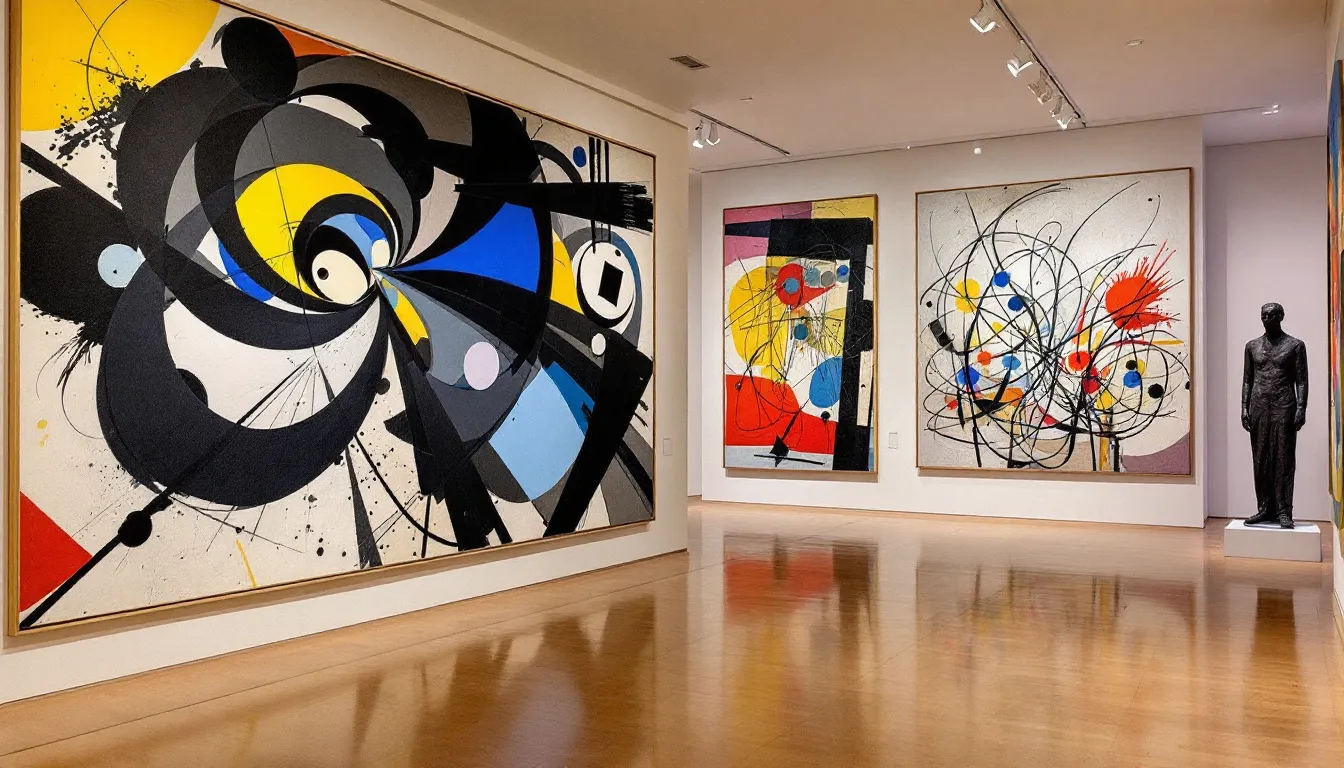
The world of abstract art is filled with notable artists whose groundbreaking works have shaped the course of modern art. From Wassily Kandinsky’s expressive use of color to Piet Mondrian’s geometric precision and Jackson Pollock’s dynamic drip paintings, these artists have left an indelible mark on the art world.
Their contributions continue to inspire and influence contemporary artists across the globe.
Wassily Kandinsky
Wassily Kandinsky is recognized as a pioneering figure in the development of abstract art. His use of color to convey emotion and feeling is a hallmark of his work. Kandinsky’s paintings often reflect spiritual themes, aiming to evoke a profound emotional response in the viewer.
You might also love: Colorful Wall Art
 Vibrant Abstract Modern ArtFrom $89
 Abstract Art ColorfulFrom $86
 Abstract Art Colorful GeometryFrom $99
One of Kandinsky’s most celebrated works is ‘Composition VII’, known for its complex use of color and form. This masterpiece exemplifies Kandinsky’s belief in the power of art to communicate beyond the literal, inviting viewers to engage with the artwork on a deeper, more personal level.
Piet Mondrian
Piet Mondrian’s approach to abstract art is characterized by mathematical precision and a focus on harmony. His work is foundational to geometric abstraction, expressing ‘absolute reality’ through the use of geometric forms and a limited palette of primary colors. Mondrian’s contributions to abstract art have left a lasting legacy, influencing countless artists and movements.
Mondrian coined the term ‘Neoplasticism’ to describe his geometric style that eliminated real-world references. By focusing on the harmony of forms and colors, Mondrian’s work represents a quest for universal beauty and simplicity.
Jackson Pollock
Jackson Pollock is a pivotal figure in the abstract expressionism movement, known for his revolutionary drip painting technique. His work ‘No. 5, 1948’ is one of Pollock’s most famous pieces, capturing the chaotic energy of abstract expressionism through its dynamic composition and vigorous application of paint.
Pollock’s free and spontaneous approach to painting allowed him to create artworks unbound by traditional techniques. His innovative methods and intense compositions continue to inspire abstract artists today.
Evolution and Influence of Abstract Art
Abstract art’s rise in the 20th century was closely linked to broader cultural changes, including shifts in technology and philosophy. Critics regarded the Abstract Expressionism movement as a significant shift in art, emphasizing spontaneous creation and emotional intensity over traditional techniques.
The Abstract Expressionism movement, led by artists like Jackson Pollock and Mark Rothko, shifted abstract art from geometric forms to emotional expression. This evolution has influenced contemporary artists who blend abstract and minimalist elements, often using new technologies to create innovative forms.
Abstract art’s flexibility and openness to interpretation contribute to its lasting appeal. The genre’s ongoing evolution incorporates new materials and techniques, reflecting contemporary societal changes and ensuring that abstract art continues to be relevant across various eras.
Abstract sculpture extends the same principles of form, color, and composition into three dimensions, asking a viewer to move around a piece rather than view it from a single fixed point. Common materials range from bronze and welded steel to carved stone and cast resin, each lending a different weight, texture, and relationship to light and shadow. Because a sculpture occupies real space, scale and placement matter more than with a painting; a piece that feels dramatic on a pedestal can feel oversized or lost depending on a room's proportions and its surrounding negative space. Outdoor abstract sculpture also introduces additional material considerations, since pieces must withstand weather and temperature changes over time.
The Role of Abstract Sculpture
Abstract sculpture transforms the visual language of painting into a tangible, three-dimensional format. Artists like Constantin Brâncuși are known for emphasizing simplicity and form in their abstract sculptures. These sculptures often focus on the essence of the subject, stripping away unnecessary details to highlight the purity of form.
Alexander Calder introduced movement to abstract sculpture with his innovative mobile designs. Calder’s mobiles are a testament to the dynamic possibilities of abstract art, as they interact with their environment and invite viewer engagement.
Non-traditional materials in abstract sculpture allow for creative exploration beyond conventional boundaries. These sculptures often highlight the artist’s technique and materials, contributing to the overall experience and inviting viewer interaction.
Creating Abstract Art: Challenges and Techniques
Creating abstract art can be a challenging and rewarding experience. Here are some techniques and tips for artists looking to explore abstract art:
Experiment with Different Materials: Abstract artists often experiment with various materials, such as paint, ink, and paper, to create unique textures and effects. By exploring different mediums, artists can discover new ways to express their ideas and emotions, adding depth and complexity to their work.
Use Color and Composition: Color and composition are essential elements of abstract art. Artists can use color to evoke emotions and create mood, while composition can be used to create balance and harmony. Experimenting with different color palettes and compositional arrangements can help artists develop their unique style and voice.
Emphasize Process Over Product: Abstract art often emphasizes the process of creating art rather than the final product. Artists can focus on the physical act of painting, the emotional expression, or the intellectual exploration of ideas. By prioritizing the creative process, artists can produce more authentic and meaningful works.
Practice and Patience: Creating abstract art requires practice and patience. Artists should be willing to experiment and take risks, and be patient with the process of creating art. Developing a consistent practice and allowing time for reflection and growth can lead to more successful and satisfying artistic outcomes.
Common Misconceptions About Abstract Art
Many people believe that abstract art is random and without meaning, but it often conveys deep emotions and personal significance through sophisticated techniques and careful planning. The misconception that it is simple and lacks skill overlooks the complexity involved.
Another common myth is that abstract art is not for everyone. In reality, its ability to resonate through personal interpretation makes it accessible and meaningful to a wide range of people, allowing viewers to connect with it on a personal level.
Understanding and Appreciating Abstract Art
Abstract art can be challenging to understand and appreciate, but here are some tips for viewers:
Look for Emotional Resonance: Abstract art often evokes emotions and moods. Viewers can look for the emotional resonance of the artwork and how it makes them feel. By connecting with the emotional aspects of the piece, viewers can gain a deeper appreciation for the artist’s intentions and the work’s impact.
Complete the look with Geometric Art
 Abstract Art Geometric ShapesFrom $89
 Abstract Art Cosmic GeometryFrom $99
 Abstract Art Dark GeometryFrom $99
 Abstract Art Dynamic GeometryFrom $99
Consider the Composition: Composition is a key element of abstract art. Viewers can look at the arrangement of shapes, colors, and forms to understand the artist’s intentions. Analyzing the composition can reveal the underlying structure and balance of the artwork, providing insight into the artist’s creative process.
Read the Artist’s Statement: Many abstract artists provide statements about their work, which can provide insight into their intentions and inspirations. Reading the artist’s statement can offer valuable context and enhance the viewer’s understanding of the artwork.
Take Your Time: Abstract art often requires time and contemplation to fully appreciate. Viewers should take their time to look at the artwork and reflect on their response. By spending time with the piece, viewers can uncover new layers of meaning and develop a more profound connection with the art.
Why Abstract Art Remains Relevant Today

Abstract art remains relevant today because it continues to evoke emotions and provoke thought. Art education plays a crucial role in enhancing creative expression and inspiring others to engage in painting.
It encourages viewers to think differently about what art can be, breaking away from traditional boundaries and exploring new possibilities.
Contemporary artists use:
-form
-color
-texture
-lines
-contemporary art
to create fine art abstract art that resonates with today’s audiences.
The enduring appeal of abstract art lies in its ability to communicate on an emotional level. People appreciate abstract art for its power to evoke feelings through color and shapes, making it a timeless and influential art form.
The Role of Abstract Art in the Art World
Abstract art has played a significant role in the art world, challenging traditional notions of representation and realism. Here are some ways in which abstract art has impacted the art world:
Challenging Traditional Representation: Abstract art has challenged traditional notions of representation and realism, opening up new possibilities for artistic expression. By moving away from literal depictions, abstract art has expanded the boundaries of what art can be, encouraging artists to explore new forms and ideas.
Influencing Modern Art: Abstract art has influenced modern art movements, such as expressionism, surrealism, and pop art. The innovative approaches and techniques developed by abstract artists have paved the way for subsequent movements, shaping the trajectory of modern art.
Providing a Platform for Experimentation: Abstract art has provided a platform for artists to experiment with new techniques, materials, and ideas. This spirit of experimentation has led to groundbreaking developments in the art world, fostering creativity and innovation.
Expanding the Definition of Art: Abstract art has expanded the definition of art, challenging traditional notions of what constitutes a work of art. By embracing non-representational forms and emphasizing the creative process, abstract art has broadened the scope of artistic expression and redefined the possibilities of fine art.
By understanding the various types, techniques, and impacts of abstract art, both artists and viewers can gain a deeper appreciation for this dynamic and influential art form.
Summary
In summary, abstract art is a dynamic and versatile art form that has evolved significantly since its emergence in the early 20th century. From its defining characteristics and key movements to the notable artists who have shaped its course, abstract art continues to influence and inspire contemporary artists. Its ability to evoke emotions, provoke thought, and encourage personal interpretation ensures that abstract art will remain a vital and relevant part of the art world for years to come.
Frequently Asked Questions
What defines abstract art?
Abstract art is defined by its focus on colors, shapes, lines, and textures, moving away from traditional realism to express ideas and emotions without depicting recognizable objects.
Who were some pioneers of abstract art?
Pioneers of abstract art such as Kazimir Malevich, Piet Mondrian, and Wassily Kandinsky significantly transformed the art world by moving away from traditional representation. Their innovative approaches laid the groundwork for future developments in abstract expression.
What are the key movements within abstract art?
The key movements within abstract art are geometric abstraction, abstract expressionism, and Color Field Painting, each offering distinct contributions to its evolution. Understanding these movements enriches one's appreciation of abstract art's diversity.
Why do some people find abstract art difficult to understand?
Many people find abstract art difficult to understand because it relies on non-representational forms that express complex emotions and concepts, necessitating a personal engagement to interpret its meaning.
How has abstract art evolved over time?
Abstract art has evolved significantly by adopting new materials and techniques, mirroring societal changes, and merging aspects of abstract and minimalist styles. This continuous transformation has kept the movement relevant and engaging.


